


A conversation between Craig Czarny and Gerhana Waty
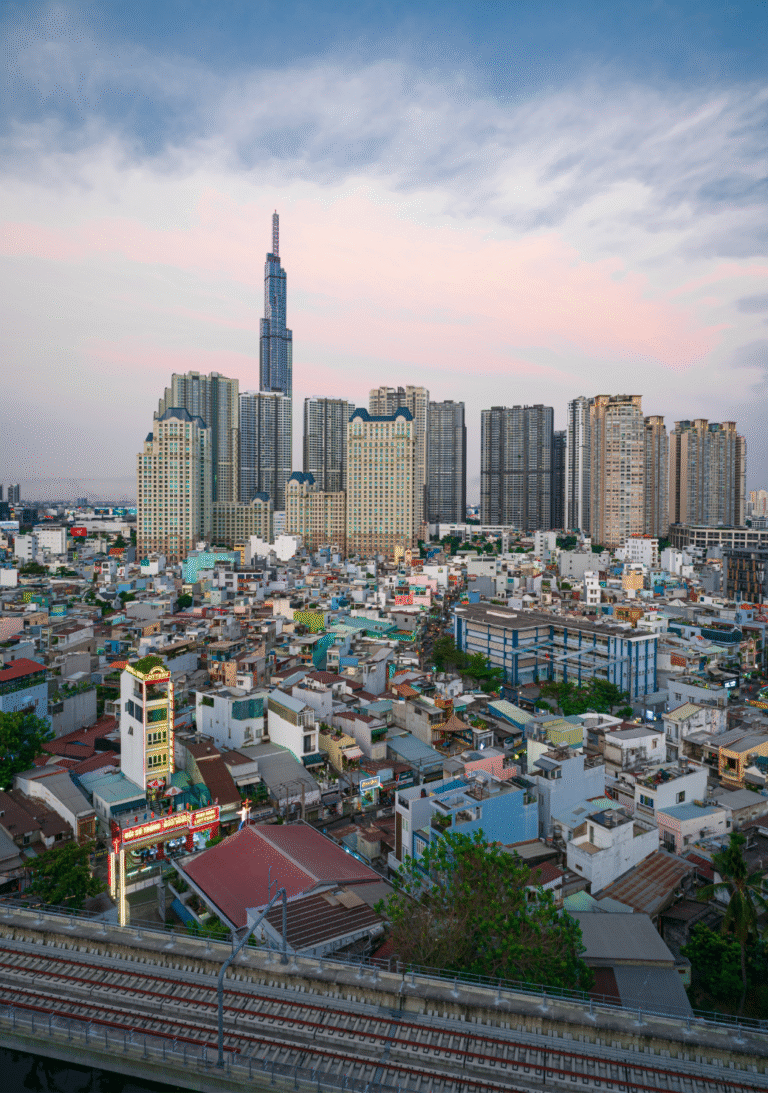
Asian cities have long been the stage for ambitious demonstrations of future city ideals. They often seek to showcase advancements in technology, infrastructure and planning while concurrently grappling to manage basic threats that come with rapid urbanisation. In Asian cities, we observe the paradox of grand ambition side by side with unbridled urban chaos and informality. But beneath this constant tension, it is the city’s streets that hold true as places that support life and serve as the medium for culture, commerce and identity.
In this conversation, Hansen Partnership urban design directors – Craig and Gerhana – delve into the profound significance of streets in Asian cities as a bedrock for future city thinking from their extensive and diverse life and working experiences. They shed light on the invaluable lessons offered by secondary city, town and village streetscapes, emphasising the importance of sustainable and community-focused urban living as the essence of future cities.
Craig Czarny (CC): We have spent the past few decades working in some of the most dynamic and rapidly growing cities across Asia. Some have embraced the latest planning discourse and are constantly evolving. But rapid growth has come with significant challenges – noise and air pollution, crippling congestion, and social inequality.
While some of these places are seen as symbols of progress, they also face some of the most pressing challenges of our time. As urban designers and planners, we have an opportunity to apply our observations and learnings to the design of future cities. The challenges facing Asian cities are complex, but by no means insurmountable – so what are the lessons that you think are meaningful?
Gerhana Waty (GW): We can look at Singapore – a successful transformation from a humble port city into a global financial hub. Many national capitals are seeing Singapore as a model, but it is vital to remember that Singapore’s (cultural, geographic, politico-economic) context is not replicable. Most other cities have failed to emulate or deliver a comparable response – often prioritising economic-infrastructure growth over human-centric/ spatial design.
Creating a better future for rapidly growing cities of this kind is possible only by prioritising people first. This means putting a focus on public spaces and streets that support social programs, cultural programs, public transportation, environmental initiatives, and human interaction at the highest tactile level.
CC: Indeed, there is something about the relentless pursuit of progress in some of these cities which neglects the physical/ cultural fabric (what we call character) with detrimental effects on community and belonging. We have seen some neighbourhoods completely transformed to make way for development programs – but somehow, the streets sustain.
And sometimes within a matter of months, the armature of the street (even in newly built districts) comes to life with shoplets, street stalls, informal cooking and dining spaces, and even micro-urban agriculture. Despite the modernity above, the streets seem to hold true.
GW: It is also the structure of these street spaces – and adjoining functions which invite this kind of granular activity. We have learnt through collaboration with local practitioners that traditional and deeply entrenched city by-laws play a crucial role in the organisation of urban and street spaces. The laws have not changed, but the way people utilise the streets have.
The peculiar five-foot way (or more in some instances) within a landowner’s title adjoining the street creates a street setback that becomes an ‘in-between’ space. Sometimes it is used for motorbike parking, outdoor trade, or a quasi-seating/ neighbourhood kids play-space. Often, it also absorbs level changes between the street and floorplate. It is fertile ground for opportunistic urban living and public-private interaction.
CC: The street scene seems to be the common thread in so many models of the Asian urban condition, whether they are MegaCities, Tier 1 cities, secondary cities, towns or villages. Almost in spite of the changes going on around them, the ground plane offers the most valuable lessons in opportunistic and community-focused urban living.
If anything, future cities for us is about future streets and ensuring that within that rigid model that they are amenable, safe, equitable to all users, engaging (activated) and good for all people on foot. It’s also critical for them to express a vernacular – reflecting local custom, ways of life, environment and economy. A local street life in Penang, is not quite the same as in Hoi An or in Makassar.
GW: But there are a few ingredients that characterise streets in the Asian urban context that are not spatial.
How about the opportunistic nature of activities occurring in street-side shops and tenancies, actively demonstrating recycle, reuse and the stretching of limited space and resources? We might consider this charming or fascinating, but it is a result of a mash-up of private and public functions.
Day and night, these streets are rare outdoor places in cities and towns typically devoid of structured public open spaces. These streets provide the stage for spontaneous interactions, cultural exchanges (remember wedding and funeral canopies we saw stretching over streets in Surabaya) and community gatherings. That is what really fosters positive urban living that should be emulated by a future city.
CC: True, there is a lot more though that can be done to contemporise the condition. Twenty-first century streets are not those we know as conduits for bikes, cars and more recently trucks and buses. In the digital age – and climate crisis (think heat island effect/ seasonal monsoon inundation) there is scope for a new street case study.
Streets that exhibit water sensitive urban design (WSUD), urban greening (trees or understorey), canopy shelter, optimised walking surfaces, and integrated infrastructure are all possibilities, but importantly not to the detriment of the vitally active public private street edge.
GW: The future looks bright for these cities if we can get that ground plane right. Of course, the overambitious visioning and master planning will continue – but if the lessons of the urban block framework and street condition can be entrenched in local laws and regulation, then there is some faith that street life can survive – if not thrive.
Of course, there are relationships between what happens above and at the ground level plane that require attention (i.e. surveillance, impacts of shadow or wind as a result of building profile), but I am not certain that these determine success. It is the horizontal plane that deserves our ongoing attention and dedication.
-ends-
Author bios
Craig Czarny is a landscape architect and urban designer with over 35 years’ experience across practice on local and international projects. Craig is founding director of Hansen Partnership’s design group, a Fellow of PIA and AILA and an honorary principal fellow at the University of Melbourne’s School of Landscape Architecture.
Gerhana Waty is the urban design leader at Hansen Partnership. She advocates for equitable urban mobility through her leadership in the Streets for People initiative. Her expertise shapes inclusive urban landscapes, emphasising non-motorised mobility. Gerhana’s international recognition stems from her impactful work in public spaces. She mentors in academia and advocates for inclusive design principles in the Urban Design Forum.