


The Vietnam International Financial Centre (VIFC) has been a gradually unfolding initiative since its announcement in mid-2025.
Ambitious in scope, it aims to deepen Vietnam’s integration into regional and global capital markets through a specialised legal and dispute‑resolution framework, targeted tax and regulatory incentives for financial and fintech activity, and a ‘one centre, two destinations’ platform spanning capital‑markets and innovation hubs in Ho Chi Minh City and Da Nang. Proponents see significant potential to attract international investors and position Vietnam as a regional financial hub, while critics are focused on how independent the VIFC will be in practice and whether Vietnam can mobilise the necessary skills and institutions to deliver on its promise.
The AVPI has prepared this paper to outline the status of the VIFC one month on from its launch, clarify what problems it is designed to address, and highlight the opportunities it may create for Australian businesses. If you are seeking a concise, practical explanation of how the ‘one centre, two destinations’ model works and where Australian capabilities align with Vietnam’s evolving financial ecosystem, this is the article for you.
What is the VIFC?
The VIFC is a “one centre, two destinations” platform spanning Ho Chi Minh City (HCMC) and Da Nang. VIFC – HCMC, launched on 11 February 2026, serves as the primary hub for capital markets, banking, aviation finance and full-service financial activities. VIFC – Da Nang, launched on 9 January 2026, is positioned as the innovation hub for fintech, digital assets and green/sustainable finance. Both sites are anchored in Vietnam’s long term strategy to become a leading regional financial hub and are backed by senior political leadership.
Legal Foundation and Dispute Resolution
The VIFC framework is based on Resolution 222/2025/QH15, which establishes designated IFC zones with customised legal, regulatory and tax regimes tailored to international investors.
A specialised court and integrated arbitration system is a landmark institutional innovation intended to provide faster, more predictable dispute resolution. It includes English as the primary language of proceedings, with Vietnamese translation when necessary, and participation by foreign judges and lawyers in specified circumstances. Digitalised procedures for filings, evidence and payments, together with strengthened recognition of foreign arbitral awards and judgments, align the IFC’s legal environment more closely with international practice. For Australian businesses used to rules based, arbitration friendly jurisdictions, this change improves legal certainty, while recognising that the “working reality” will depend on detailed regulations and court practice over time.
Incentives and Scale
The IFC regime offers several key benefits: preferential corporate income tax for eligible financial and fintech activities, targeted personal income tax relief for IFC experts to around 2030, long tenure land leases with priority access to strategic sites, and more liberal foreign exchange and cross border‑ capital rules for qualifying entities. While the overall orientation is clearly pro investment and pro innovation specific rates and concession periods are defined in sub law‑ and should be confirmed for each transaction.
Ho Chi Minh City
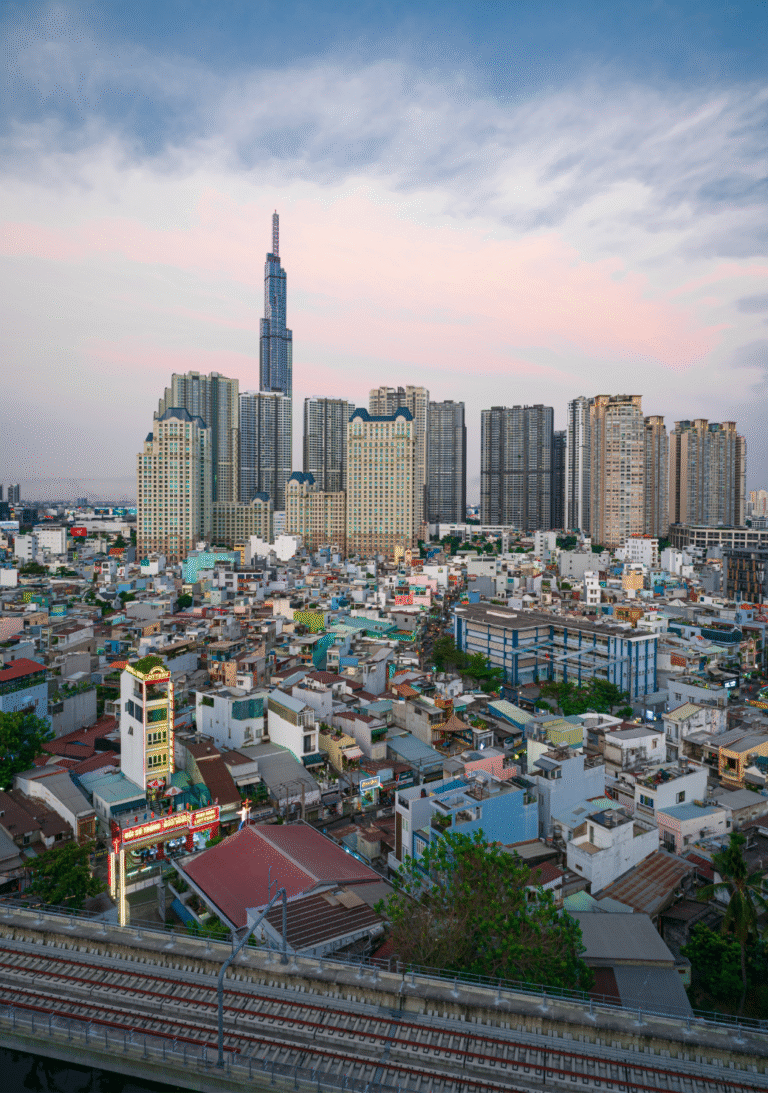
In HCMC, the IFC covers roughly 898 hectares across Saigon Ward, Ben Thanh Ward and Thu Thiem, including a core financial precinct of about 9 hectares, under a master plan with an indicative investment envelope of roughly VND 172 trillion (≈ AUD$9.2 billion). Founding members include Sovico Group, MB Bank, TPBank, SHB, Son Kim Capital, VinaCapital and Nasdaq, supported by strategic Vietnamese institutional partners. Early momentum has been most visible in two areas: a HCMC-based aviation finance platform expected to mobilise more than AUD$8 billion in capital, and growing interest from major digital platforms in using the city as a regional hub for selected financial and cross-border commercial operations.
Da Nang: Sandbox and Green Finance Hub
Da Nang’s IFC is embedded in the city’s high-tech‑ parks, deepwater port and logistics corridors, positioning it as Vietnam’s principal testing ground for fintech and green finance. A flagship 36‑ month Basal Pay blockchain pilot operates‑ as a tightly regulated sandbox to safely test how digital assets can be converted into Vietnamese dong (VND). Additional sandboxes in digital payments, tokenisation and digital ‑banking models are planned for 2027, complemented by work on commodity and carbon linked market infrastructure aligned with Vietnam’s energy‑ transition agenda. New IFC‑linked facilities at Software Park No. 2, a working space for IT engineers and investors in semiconductor industries and micro chip design, are under construction as part of a broader digital services complex, reinforcing Da Nang’s role as a regulated launchpad for models that can later scale nationally and across ASEAN. For foreign fintech and green‑ finance players, Da Nang offers a combination of regulatory experimentation, city‑ level‑ support and visibility.
Strategic Pillars and Australian Entry Points
VIFC is structured around four strategic pillars – international capital markets, financial services, digital banking/fintech and new financial products – which closely match Australian strengths. Concrete opportunities for Australian firms include:
- International capital markets – Establishing IFC based funds and vehicles (including superannuation linked structures) to mobilise capital into Vietnamese infrastructure, renewable energy and digital economy projects.
- Financial services – Providing cross border legal, regulatory, tax and dispute resolution advisory services into the specialised court and arbitration ecosystem.
- Digital banking and fintech – Developing agribusiness and commodity finance structures, as well as green and sustainability linked finance and carbon market services.
- New financial products – Piloting payments, remittances, embedded finance and regulatory technology solutions in Da Nang’s sandboxes, then scaling successful models into Vietnam and ASEAN.
For Australia–Vietnam economic engagement, the VIFC should be seen as a long-term structural platform rather than a one-off initiative, offering meaningful first-mover advantages to firms able to navigate a rapidly evolving, but increasingly international-standard, regulatory environment. For Australian firms, the deeper significance of the VIFC lies in its potential to shape the strategic, regulatory and institutional context for long-term engagement with Vietnam.